Web Stories
Sugar-Coated Sexism: AI Fruit Videos Are Colourful, Entertaining, And Deeply Sinister


I never thought I’d be spending my time watching suspiciously curvy cartoon fruits living in a dramatic Ekta Kapoor-esque world. But here we are. If you’ve somehow avoided these AI fruit videos entirely, congratulations. Please share your screen time habits. For the rest of us: AI-generated fruit and sweet characters have colonised our Instagram feeds, starring in their own micro-dramas complete with cheating spouses, scheming villains, and moral lessons that always, somehow, land on the same target. At first glance, they seem harmless. Silly, even. Internet fluff designed to kill 30 seconds while you wait for your cab or avoid replying to emails. But spend some time actually watching them, and an ugly, but not unfamiliar pattern starts to emerge.
What’s wrong with these AI fruit videos?
View this post on Instagram
These videos are deeply sexist and alarming because most of these videos are not really about fruit or sweets at all. They are about women. More specifically, they are about reducing women into the same recycled stereotypes we’ve been fed for years: the gold digger, the manipulator, the cheat, the seductress, the “modern woman” who only wants money and attention. The difference now is that the message is wrapped in AI slop, absurd humour, and shiny visuals that make it feel unserious enough to escape criticism.
Here’s how a typical plot goes: a mango wife ignores her devoted guava husband and runs off with a rich watermelon who showers her in diamonds. The watermelon eventually leaves her because obviously, she’s not an “ideal” woman. Meanwhile, the guava has quietly become insanely wealthy. The mango, now alone and broke, begs guava for a second chance. But mango is left alone as a punishment for leaving an honest, devoted man.
If this reminds you of a 90s Hindi serial where the woman was always either a prop or a villain, that’s because it’s the same story. It’s just packaged in a 2026 format. Sometimes, the video flips the script — a woman makes the right choice and gets rewarded for being loyal and pure. Which is, if anything, worse. Because now there’s an entire moral test built around whether a woman meets male approval. Either way, she’s being judged.
“It’s just a video, who cares?”
When a harmful idea arrives wearing a cartoon peach costume, it gets a free pass that it would never receive in any other format. The absurdity is the whole defence mechanism. Nobody is seriously claiming you can determine a woman’s character by which fruit she picks but it is subtly and subconsciously promoting a mindset. Sexist jokes in the 70s were just banter. Degrading reality TV in the 2000s was just entertainment. Every era wraps the same tired ideas in a shiny new package and uses that package as an excuse to not take those ideas seriously.
Alessia Tranchese, Associate Professor of Language, Feminism and Digital Media at the University of Portsmouth, says these videos centre on “highly stereotyped narratives” that almost always feature “a female-coded character — typically young and conventionally attractive — who is depicted as cheating on her partner with a male-coded character portrayed as wealthier or higher status.” She adds that the narratives mirror “themes commonly found in manosphere discourse, particularly the idea that women exploit ‘good’ men for financial or social gain.”
So yes, what looks like a silly cartoon drama is, at its core, the same ideology that thrives in the darkest corners of the internet. The format is new, but these ideas are what form the foundation of the manosphere online.
The workplace harassment problem nobody’s talking about

It isn’t just romantic storylines, either. These videos repeatedly normalise workplace harassment. Male bosses pressure or exploit female fruit characters, and the videos use it for drama and laughs. And the comment section’s response? Laughing emojis. Hearts. “When is the next part coming?” The fact that people aren’t even pausing before laughing at a female character being coerced by her boss says something worth sitting with. We’ve watched people turn real conversations about workplace harassment into cultural flashpoints, then repackage the same dynamic as consequence-free entertainment because it’s happening to a cartoon.
Why the algorithm loves this content
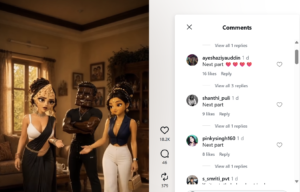
Instagram’s algorithm does not care whether content is intelligent, ethical, or even coherent. It cares about engagement. If people pause, comment, rage, laugh, share, or hate-watch, the machine reads all of it as success.
These AI videos are engineered perfectly for that economy. The format is bizarre enough to stop the scroll because watching fruits and vegetables live dramatic human lives was never on anyone’s bingo card. But what really drives the numbers is that the content is sexually suggestive, morally provocative, and hits the exact stereotypes that generate strong reactions across the board. The people who relate to it engage. The people who are offended by it engage. The algorithm cannot tell the difference, and frankly, it doesn’t need to.
The demand floods the comment section: “When is the next part?” The algorithm sees the activity and pushes the video harder. More creators notice what’s performing and replicate the formula. The cycle continues, and with each round, the content gets slightly more extreme because that’s how you keep the clicks coming.
What the comments tell us about society
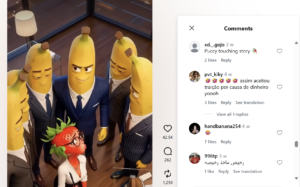
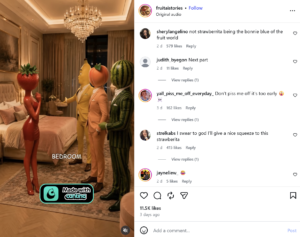
If you want to understand the real impact of these videos, don’t watch the videos. Read the comments, and you’ll find enough filth to nauseate you. The intention with which the female fruits are generated is well perceived and responded to by the audience. This is also primarily the reason behind the oversexualisation. The makers know people will watch it and be eager enough to wait for the next episodes.

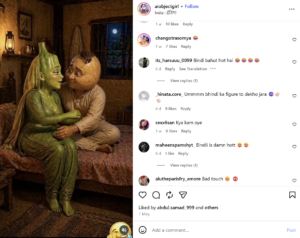

The fact that we are so invested in such poorly written stories is something we all need to think about. The most uncomfortable part isn’t the trolls or the arguments. It’s the teenagers on the internet absorbing these ideas. These videos are not teaching them anything new; they’re just reinforcing, relentlessly and cheerfully, ideas that were already in the water.
Featured Image Source
More from All About Eve
40 Men In 3 Hours: What Happened When A Cop Disguised Herself As An Ordinary Woman At Night
Who Decides What’s Beautiful? Inside The Racial Bias Of AI Beauty Tools
Looksmaxxing: India’s Beauty Standards Crisis Is A Men’s Problem Too
- Share:
-

-

-