Web Stories
Muamma Drama Review: Saba Qamar Plays A Femme Fatale You Can’t Ignore


Saba Qamar’s latest show, Muamma, is dominating not only our YouTube watch history but also our conversations. The show is slow, psychological, and different from Pakistan’s conventional dramas. From the very first glimpse, the drama establishes itself as a puzzle, and as you watch, it poses so many questions that you can’t stop watching. In Muamma, Saba Qamar plays a woman who befriends, manipulates, and destroys with equal measures of charm and calculation, and the truly disquieting part? You can’t quite decide whether to despise her or love her.
The simple yet unsettling premise of Muamma

Muamma, which translates to “mystery” or “puzzle”, centres on Jahan Ara (known affectionately as Jigi), a financially independent woman who rents out portions of her grand, mysterious house exclusively to newlywed couples. On the surface, she is courteous, refined, and quietly authoritative. She is the sort of woman who commands respect without ever asking for it.
However, the real story begins behind closed doors. Hidden within her home is a secret room with a one-way mirror, from which Jahan Ara observes her tenants without their knowledge. She watches their private moments, particularly focusing on the men. Her care is just a weapon to become a part of her tenant’s life.
The drama opens with Jahan Ara’s “first hit”, Zeeshan (Nabeel Zuberi), a tenant who, in a stupor, declares his love for Jahan Ara in front of his neighbours and pregnant wife. The marriage ends in divorce, Zeeshan is sent to prison (how Jahan Ara manages this so swiftly adds to her sense of ominous power), and a new couple moves in.
Once again, we are watching her pattern unfold. Junaid (Ali Ansari) has already expressed his love for Jahan Ara despite his wife Maira’s pregnancy, engaging in nighttime conversations that Maira (Anoushay Abbasi) remains oblivious to. Episodes 10 and 11 bring a twist to the show. Jahan Ara’s carefully constructed world of consequence-free manipulation suddenly faces the possibility of exposure.
What makes Muamma so addictive?
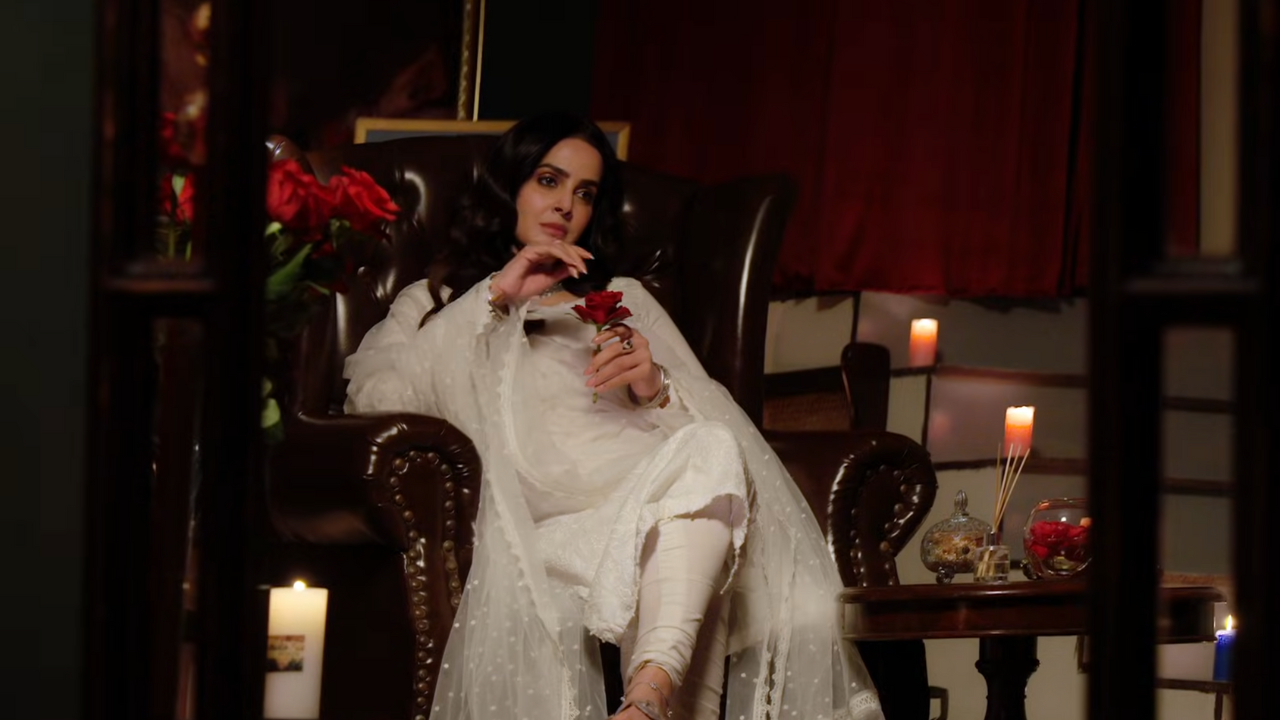
If there’s one reason to watch Muamma, it’s Saba Qamar’s performance as Jahan Ara. This isn’t the empowered heroine or the wronged woman seeking justice that Pakistani television often celebrates. Jahan Ara is something far more complex and considerably more dangerous: she’s the villain of her own story, and Qamar plays the antagonist with brilliance. Her expressions are minimal, her voice measured, her body language deliberately closed off. There are no theatrical outbursts or melodramatic reveals.
Early episodes establish Jahan Ara through controlled normalcy as she’s elegant, financially stable, and emotionally guarded. But as the drama progresses, we see glimpses of the trauma that created this woman: a controlling, vicious, cheating husband now imprisoned for murder, a father who threw her out, a helpless mother, a greedy brother. She loved another man (played by Usman Mukhtar), but was forced into a brutal marriage instead. And on top of it all, the loss of her unborn child. The void in her life, it seems, is filled by creating voids in others’ lives, as though she wants everyone to suffer precisely as she did.
What makes Muamma so addictive is how the story unfolds. As the episodes progress, the show hints that Jahan Ara’s actions are not random. Her fixation appears rooted in her own unresolved past. Yet the drama resists offering easy psychological explanations. She isn’t positioned as a villain or victim. The show lets us decide what we make of Jahan Ara and her actions. Is she exposing men’s moral weaknesses? Is she performing sisterhood by exposing unfaithful men? Or regaining the agency that was taken away from her?
There are no easy answers. As we wait for new episodes to release, it’s hard to predict what will happen next. So far, Muamma looks like more than just entertainment; it raises questions that make us uncomfortable.
Featured Image Source
More from All About Eve
Case No. 9: The Real Villain Of Saba Qamar’s Drama Isn’t The Rapist
Why Narcissists Like Pamaal’s Raza Are Harder To Spot Than You Think
Daldal Series Review: Not Bhumi Pednekkar, Samara Tijori Is The Star Of This Crime Thriller
‘Mardaani 3’ Review: Rani Mukerji Delivers Another Knockout Performance In This Crime Drama
Is O’Romeo A Shakespeare Adaptation? Here’s The Truth Behind Vishal Bhardwaj’s Film
- Share:
-

-

-