Web Stories
“People Waste So Much Time”: Radhika Apte Calls Out Bollywood’s Long Work Hours, Supports Deepika Padukone


The Indian film industry has always worn its insane work hours like a badge of honour. Lately, there has been a debate around Bollywood’s work culture triggered by reports of Deepika Padukone asking for an eight-hour work day on film sets. On AfterHours With All About Eve, Radhika Apte and Divyenndu Sharma showed support for the actor’s eight-hour clause. They explained what working in films actually demands and why that demand has gone largely unquestioned for far too long.
Hard work, taken too far
Radhika began by pointing out something anyone who has spent time on a film set knows to be true: the sheer commitment of the people involved. “People here are incredibly hard-working,” she said, describing an environment where crew members routinely go above and beyond, giving everything they have to make a project work. That dedication, however, comes at a cost. “The work ethic is also terrible,” said Radhika. Long hours have become the norm, not the exception. While 12-hour shifts are officially standard, they often stretch well beyond that once travel, preparation, and waiting time are added in. “Nobody gets time any time at all”, Radhika observed. The debate, she explained, isn’t about passion or professionalism but about the lack of limits in Bollywood’s work culture.
When work leaves no room for family

The conversation grew more personal when Radhika spoke about returning to work shortly after becoming a mother. “I was doing a couple of films this year when my daughter was just three months old, and then I decided I had to stop.” She decided that if she continued working, she would limit her day to 12 hours door-to-door, including travel, hair, and makeup. In talking to friends, she realised her experience was far from unique. Many mothers in the industry step back from work for years because film sets offer little flexibility for caregiving. And with fathers, they don’t see their children for weeks because of late and long work hours. “That’s our culture,” Radhika said. “And it’s really sad.”
The eight-hour work debate
When host Bani Anand said many people argue that filmmaking isn’t corporate, it’s art, and you can’t box it into fixed hours, Radhika challenged this by pointing out that filmmaking is also a business, and it’s as corporate as it could get. In fact, she shared an example from an independent film she worked on that followed eight-hour shifts, and everything was done efficiently. “Out of 12 or 14-hour shifts, people waste so much time. If it were an eight-hour shift, people would probably focus more and work faster. It could actually bring efficiency that we currently don’t have.”
“We’re not saving the world”
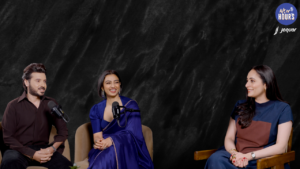
Divyenndu added perspective by addressing how normalised extreme work days have become. On paper, film shoots may run for 12 hours. In reality, he said, most people end up working 15-16 hours on a regular day. The comparison he made was striking. Such schedules resemble those of the army, except, as he put it plainly, “We’re not saving the world.” What troubled him was not just the long hours, but how proudly the industry wears its exhaustion. While actors have some level of visibility and choice, much of the industry does not. Spot boys, lighting technicians, assistant directors, and many others work continuously, often without proper breaks, simply because the system expects them to.
Radhika and Divyenndu were careful to acknowledge the privilege that actors hold, while also pointing out how uneven the working environment truly is. Film sets, Radhika noted, are deeply unequal spaces, where some can cancel shoots on a whim while others absorb the consequences. Over time, the effects become obvious. Poor sleep, neglected health, burnout, and mental fatigue quietly pile up, rarely discussed but widely experienced.
“The ones who romanticise it the most are often the ones getting paid the highest and actually not working those hours. Ask any AD on set, and they’ll tell you. It’s incredibly difficult,” Divyenndu added.
The industry may continue to celebrate the grind, but conversations like this make one thing clear: loving cinema should not mean losing yourself to it.
Watch the full episode here.
Featured Image Source
More from All About Eve
‘Raat Akeli Hai: The Bansal Murders’ Review: Nawazuddin Siddiqui Rules This Unpredictable Whodunnit
Mrs. Deshpande Review: Madhuri Dixit Trades Grace For Grit In This Thriller Web Series
“Historic Violence Led To Patriarchy In India”: Amish Tripathi On Influences In Indian Society
- Share:
-

-

-